My Own Blue Zone
In 2026, a Longevity Mentor training program was launched by Pannon Kincstár. I joined because the topic is very close to my heart.
I consider the program to be of high quality. It offers many fresh perspectives and has excellent instructors.
To successfully complete the Mental Health module of the training, I had to write a final paper. From the available topics, I chose “My Own Blue Zone.”
Please receive my final paper with warmth and openness.
My Own Blue Zone
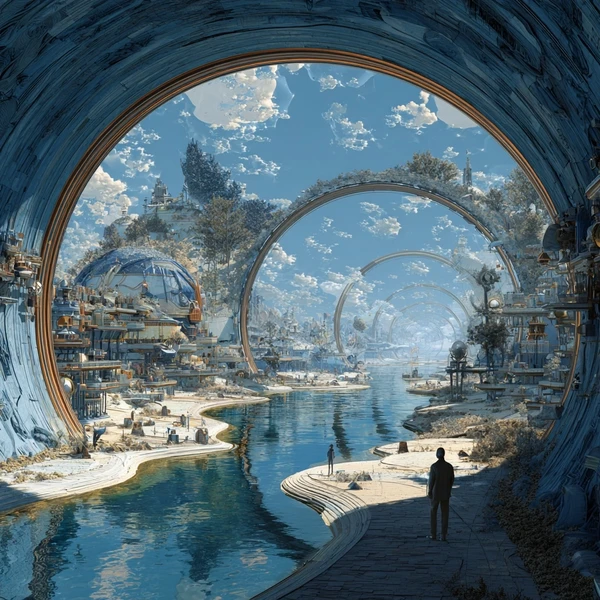
My Blue Zone is technocratic. My Blue Zone is also utopian, although I trust that one day it may become a reality for a future generation.
Theory
The concept of Blue Zones originated with Dan Buettner, a National Geographic researcher who, over the past decades, has studied the world’s longest-living people during his expeditions. The term itself arose because researchers initially marked areas on a world map with blue ink and blue dots where the proportion of centenarians was exceptionally high; the name eventually stuck.
Currently, five Blue Zones are recognized globally: Loma Linda in California, Nicoya in Costa Rica, Sardinia in Italy, Ikaria in Greece, and Okinawa in Japan. Interestingly, such regions can now also emerge through deliberate government intervention. For example, Singapore has become a new, “technically engineered” Blue Zone thanks to its excellent healthcare system and conscious urban planning, which includes strict limits on the number of motor vehicles.
Although these areas are geographically and culturally very distant from one another, the lifestyles of their inhabitants share common foundations that contribute to a vibrant, active, and happy old age. Their environments are typically close to nature, where much of everyday transportation occurs on foot. Their rhythm of life is characterized by intentional slowing down, presence, following the cyclical patterns of nature, and avoiding multitasking.
One of the most important keys to the success of Blue Zones lies in mental well-being and the sustaining power of community. These people live in multigenerational families and close-knit social networks, such as the Japanese “moai,” which serve as powerful protective factors against the loneliness, isolation, and anxiety that are becoming increasingly common today. Furthermore, they possess clear life purposes, like ikigai or plan de vida, they think in terms of “we” rather than “I,” and they live their everyday lives without the pressure to perform, while accepting difficulties and even the reality of passing away.
Choice of Topic
I don’t recall precisely when I first encountered the concept of Blue Zones, but it was probably about ten years ago when someone lent me a book on the subject. While I found the topic interesting, it didn’t immediately prompt any changes in my life; perhaps I wasn’t ready for it yet. A few years ago, however, when Dan Buettner’s Netflix series about Blue Zones was released, I was nearing the completion of my 60-kilogram weight loss journey, which made the topic particularly resonant for me.
After watching the series, I subscribed to Dan Buettner’s recipe service. I was initially surprised, and somewhat disappointed, to discover that the recipes leaned almost entirely towards a vegan approach. However, this turned out to be a valuable turning point: I realized that for me, the Blue Zone lifestyle isn’t about blindly copying pre-set patterns. Instead, it’s about understanding the underlying principles and authentically integrating them into my own life.
For instance, in the episode about Sardinia, I observed how much the inhabitants walked up and down hills, and how this constant movement contributed to their excellent physical condition. I remember thinking how wonderful it would be to live in such a place. Then it struck me: I do live in exactly such a place! My home is at the foot of the Gerecse Hills in Lábatlan, on a street where every journey begins either uphill or downhill. The only flat street in our town runs alongside the Danube, while the rest of the small town stretches across a hillside. I simply hadn’t recognized this inherent walking opportunity before, because I used to drive everywhere.
My Own Blue Zone
My ideal Blue Zone is a human-centered, technocratic environment designed to offer supportive opportunities to everyone.
At its core is a device, much like a modern sports watch, providing feedback and estimates on sleep, stress levels, activity, step count, and key health indicators such as HRV and VO2 max. This tool helps individuals identify their flow states, set goals for a healthier life, and connect with like-minded people to foster a sense of belonging.
This technological support is universally accessible and complemented by personal mentoring. In this vision, technology enhances, rather than replaces, human relationships. It offers insights into disruptions in the balance of sleep, stress, movement, or social connection. This data allows mentoring to be more personalized and conscious, with the ultimate goal being physical and mental balance, not merely the pursuit of metrics.
While technocratic, my Blue Zone prioritizes respect for nature and the planet. Our eating, traveling, and living habits are designed to preserve the living world for future generations, both on land and in water.
Mental well-being is a central pillar. For me, this means more than just the absence of illness; it signifies the presence of purpose, connection, rhythm, and inner safety. Drawing from Blue Zone principles, people thrive not as isolated individuals, but within communities, relying on one another. In our modern world, we must consciously rebuild this through family bonds, friendships, supportive communities, shared physical activity, and a life purpose that extends beyond individual success. My future tool will actively support this rebuilding process.
Regarding movement, we embrace walking and public transport. Everyone has ample time for physical activity, including achieving 7,000 to 8,000 steps daily, even through nature hikes. Other forms of movement, such as running tracks, trail-running routes, gyms, and sports fields for team games, are freely accessible.
Nutrition emphasizes locally sourced foods. Animal protein is primarily dairy-based, reflecting our respect for animal rights. The diet is rich in leafy green vegetables, legumes, whole grains, fruits, nuts, and seeds, with a modest inclusion of animal-based protein.
In this utopia, everyone has the right and the time to cultivate their mental well-being and discover their “ikigai,” enabling them to contribute meaningfully to society. Finding and fulfilling one’s life purpose and experiencing a sense of usefulness are crucial for longevity.
Collectively, these positive factors create the potential for future generations to lead longer, healthier lives.
While significant societal development is still needed, the opportunity to create our own Blue Zone is already here. We can form communities based on these shared values, creating a universal “moai” or “Blue Island.” Perhaps these individual Blue Islands will one day form the foundation for this technocratic utopia to become a reality.
Closing
The phenomenon of the Blue Zones proves that a long and healthy life does not depend solely on fortunate genetics. Instead, it is deeply rooted in our everyday habits, our community relationships, and our inner peace. By adopting principles such as having a sense of purpose, slowing down, and nurturing social connections, we can consciously create our own “personal Blue Zone” within our living environment, regardless of where in the world we reside.
For me, this is no longer merely an abstract theory. Living at the foot of the Gerecse Hills, I regularly take advantage of the area’s opportunities for walks. The sports watch on my wrist provides daily feedback on my sleep and stress levels, which I actively monitor. I am continuously refining my diet, though I admit this is the most challenging aspect of my transformation.
Through this course, I am, in fact, searching for my own ikigai.
Feel free to comment in the Facebook group.
Join our little community:
Translations:
| Last | Previous |
| Let's Begin! | Longevity on Your Wrist |